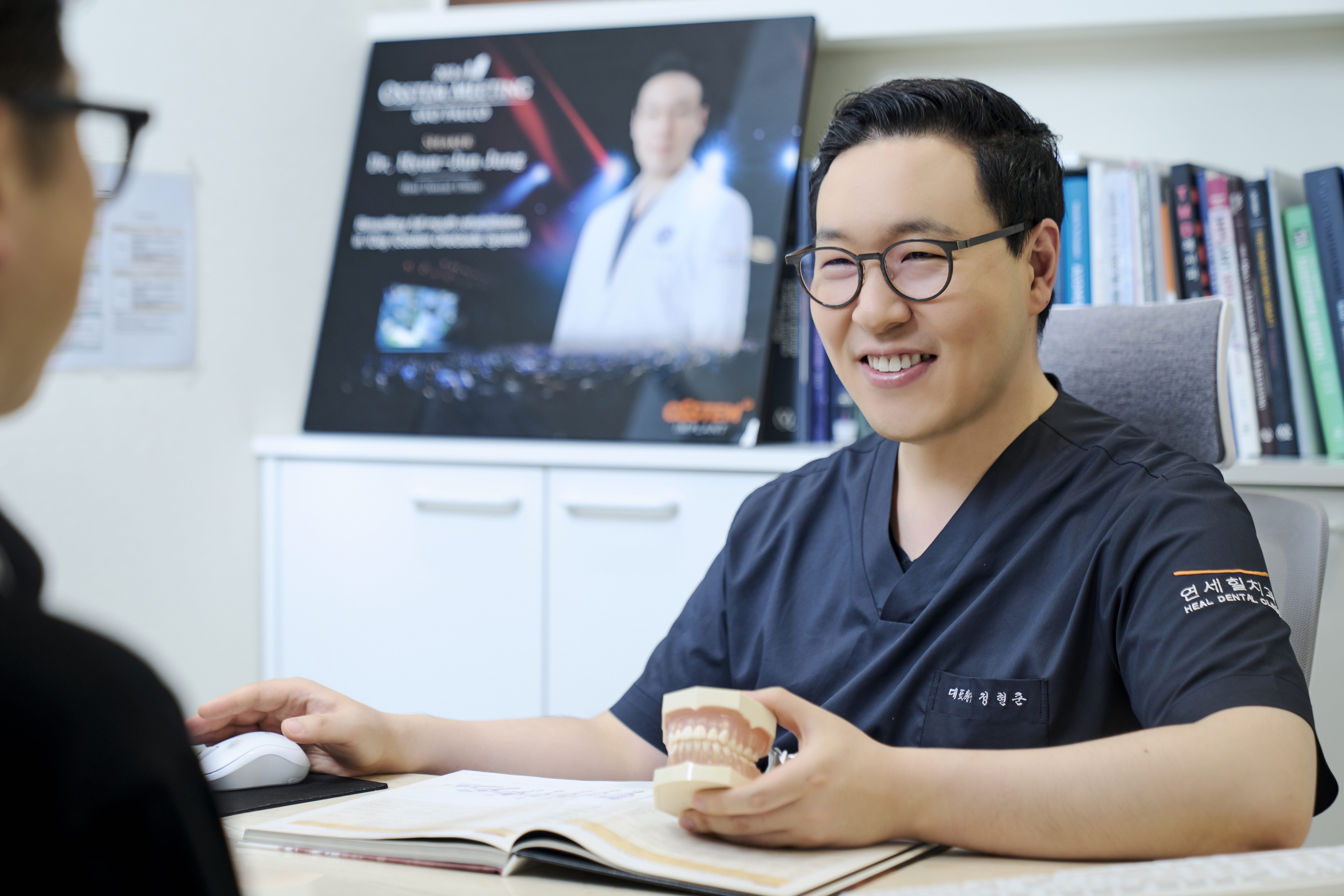
Flying across the Pacific for a dental procedure takes planning. Not the kind that keeps you up at night — the practical kind. The kind that means you arrive knowing what will happen, understand why each step matters, and don't lose two weeks of recovery time to something preventable.
Here is what matters, in the order it matters.
Before any implant surgery at a Seoul dental clinic can be planned, your surgeon needs a Cone Beam Computed Tomography (CBCT) scan — a three-dimensional image of your jaw. The American Academy of Oral and Maxillofacial Radiology (AAOMR) recommends CBCT imaging as the standard of care for implant site assessment. Standard X-rays show two dimensions; a CBCT shows bone density, height, width, nerve locations, sinus positions, and the precise anatomy of the implant site.
Many patients traveling to Seoul for dental implants arrive having already sent CBCT data to their clinic. If a recent scan (within 12 months) exists from a dentist or oral surgeon in your area, request the DICOM files — the raw digital data, not a printed image — and send them ahead of your appointment. It saves a step and can significantly accelerate your first consultation.
At Heal Dental Hospital Seoul, international patients can upload DICOM files directly through a remote consultation intake process before booking. The clinical team reviews the data, flags any anatomical considerations, and provides a preliminary treatment assessment. If no recent scan exists, one is taken on arrival — a brief, non-invasive procedure that takes approximately 15 to 20 seconds of imaging time.
A single dental implant involves two distinct phases separated by months.
Phase 1 — Surgical placement: The titanium implant post is placed into the jawbone. For most patients without complications, this procedure takes 45 to 90 minutes per implant. You'll need to stay in Seoul approximately 3 to 5 days after placement for monitoring before flying home.
Phase 2 — Osseointegration: This is the biological process by which your jawbone fuses to the titanium surface of the implant. It requires 3 to 6 months of undisturbed healing — a function of biology, not scheduling preference. Bone quality, overall health, and implant surface design all affect duration. This process cannot be rushed.
Phase 3 — Final restoration: Once osseointegration is confirmed (typically by X-ray at a follow-up appointment), the abutment and ceramic crown are placed. This second trip takes 2 to 3 days.
Plan for two trips to Seoul, separated by 3 to 6 months. Porcelain veneers, by contrast, are fully completed in a single visit of 5 to 7 working days.
Anticoagulants (blood thinners) — aspirin, warfarin, rivaroxaban, clopidogrel, and others — affect surgical bleeding and healing. Bisphosphonates, used for osteoporosis, affect bone metabolism and osseointegration. Immunosuppressants change how your body responds to surgery and infection. Diabetes affects wound healing and implant success rates.
None of these conditions automatically disqualify a patient from implant treatment. All of them require your surgeon to know about them before the procedure begins. Submit a complete medication list, including supplements and over-the-counter items, before your first appointment.
An implant placed into an infected oral environment fails. This is not a caveat — it is fundamental biology. If you have active gum disease (periodontitis), inflamed gum tissue, or infected adjacent teeth, these conditions need to be resolved before an implant post can be placed. Placing a titanium fixture into an active infection site significantly elevates the risk of peri-implantitis — infection around the implant — which can lead to implant failure.
Your Seoul clinic will assess your periodontal status during your initial consultation. If treatment is needed, it can sometimes be performed during the same visit or in the preparatory period before your surgical appointment.
The evidence on smoking and implant failure is consistent across decades of research. Smoking impairs blood flow to the surgical site, slows healing, and is directly associated with higher rates of peri-implantitis and implant failure. Most clinical guidelines recommend cessation for at least two weeks before surgery and for a minimum of eight weeks post-procedure.
After implant placement, you will eat soft food for approximately two weeks. Yogurt. Soup. Soft cooked grains. Nothing requiring the force of a bite. The reasoning is straightforward — the blood clot and healing tissue at the surgical site need time to stabilize without mechanical disruption.
The international patient coordinators at Heal Dental — who handle airport coordination, accommodation recommendations, and post-op support in both English and Korean — can point patients toward restaurants near Gangseo-gu that handle soft-food requests fluently. Seoul's food culture handles soft food exceptionally well.
Before you leave Seoul, collect the following: your CBCT scans and post-surgical imaging (in DICOM format), an itemized treatment summary in English including implant system brand and model, prescription documentation for any antibiotics or pain management issued, and your follow-up schedule and contact information for remote post-operative questions.
This documentation serves two purposes: it allows any dentist in North America to monitor your recovery and understand exactly what was placed, and it supports any HSA/FSA reimbursement claims you may file.
This article is for informational purposes only and does not constitute dental or medical advice. Individual treatment requirements, timelines, and outcomes vary. Consult directly with a licensed dental professional for guidance specific to your clinical situation.
Sources: American Academy of Oral and Maxillofacial Radiology (AAOMR) — CBCT imaging recommendation · PMC/NCBI — General implant protocol literature
태평양을 건너 치과 시술을 받는 것은 철저한 준비가 필요합니다. 도착 시 무슨 일이 일어날지 알고, 각 단계가 왜 중요한지 이해하며, 예방 가능한 문제로 2주를 낭비하지 않는 준비입니다.
임플란트 수술 계획의 첫 번째 단계는 정밀 영상 진단이다. 콘빔 CT(CBCT)는 턱뼈의 밀도, 신경 위치, 잔존 골량을 3차원으로 분석하는 핵심 자료다. 만약 미국 치과에서 최근 촬영한 CBCT가 있다면, 인쇄물이 아닌 DICOM 원본 디지털 파일을 요청해 서울 내원 전 전송해두면 상담 효율이 크게 높아진다. 힐덴탈 서울은 예약 전 원격 상담 단계에서 DICOM 파일 업로드를 지원한다.
임플란트는 한 번의 방문으로 완성되지 않는다. 1단계(식립)에서 티타늄 포스트를 턱뼈에 심은 뒤 3~5일 체류가 필요하고, 2단계(골유착)는 뼈와 임플란트가 생물학적으로 결합하는 기간으로 3~6개월이 소요된다 — 이 기간은 어떤 방법으로도 단축할 수 없다. 3단계(최종 보철)는 두 번째 방문에서 2~3일이면 마무리된다. 비니어는 이와 달리 5~7일의 단일 방문으로 완성 가능하다. 여행 일정과 휴가를 현실적으로 조율해야 후회가 없다.
많은 환자들이 처방약만 신고하고 보충제나 일반의약품은 생략하는 경우가 있다. 그러나 항응고제(와파린, 아스피린), 비스포스포네이트(골다공증약), 면역억제제, 당뇨 치료제는 모두 수술 결과와 치유 과정에 직접적인 영향을 미친다. 처방약, 시판 진통제, 건강보조식품까지 포함한 전체 약물 목록을 사전에 제출하는 것이 안전한 수술의 시작이다.
임플란트 실패의 가장 흔한 원인 중 하나는 수술 전 구강 환경의 불량이다. 활동성 치주염, 잇몸 염증, 인접 치아의 감염이 존재하는 상태에서 식립된 임플란트는 골유착에 실패할 가능성이 현저히 높다. 서울 내원 전 미국 담당 치과에서 치주 상태를 점검하고, 필요한 처치를 완료한 뒤 방문하는 것이 수술 성공률을 높이는 핵심 전제 조건이다.
흡연은 구강 혈류를 저해하고, 치유 속도를 늦추며, 골유착 실패율을 유의미하게 상승시킨다. 대다수의 임플란트 임상 가이드라인은 수술 최소 2주 전부터 금연을 시작하고, 수술 후 8주까지 금연을 유지할 것을 권고한다. 수십만 원을 절약하러 서울에 왔다가 실패 케이스가 되는 것, 금연 하나로 막을 수 있다.
식립 직후 약 2주간은 죽, 스프, 부드러운 두부 등 저작 부담이 없는 유동식 위주의 식이가 원칙이다. 뜨겁거나 딱딱한 음식, 빨대 사용은 회복을 지연시킬 수 있다. 힐덴탈 서울의 컨시어지 코디네이터는 강서구 인근 수술 후 식이에 적합한 식당을 영어와 한국어로 안내하며, 귀국 전까지의 회복 일정 관리를 함께 지원한다.
서울을 떠나기 전 챙겨야 할 서류는 명확하다. DICOM 형식의 CBCT 스캔, 영문 치료 요약서(임플란트 브랜드 및 모델명 포함), 처방 기록 전체, 원격 사후 관리 연락처. 이 서류들은 귀국 후 미국 치과에서의 연속 사후 관리를 가능하게 하고, HSA/FSA 환급 청구의 근거 자료로도 활용된다. 준비된 환자는 귀국 후에도 관리가 이어진다.
시술 결과, 치료 기간 및 비용은 개인의 구강 상태에 따라 상이할 수 있습니다. 본 콘텐츠는 정보 제공 목적으로 작성되었으며, 의료적 조언을 대체하지 않습니다. 치료 결정 전 반드시 면허 치과 전문의와의 상담을 권장합니다.
방문 계획 시작하기 →Related Articles · 관련 기사
Ujangsan Harrington Tower 1F-2F, Gangseo-gu, Seoul, Korea
☎ +82-2-2697-2875 · ✉ healdentalclinic@gmail.com
🌐 365implant.com · 💬 KakaoTalk / 카카오톡 · WhatsApp · ▶ YouTube
Open 7 days a week · English concierge available · 주 7일 진료 · 방문 전 원격 상담 가능