Why Veneers Look Artificial: A Seoul Specialist's Perspective
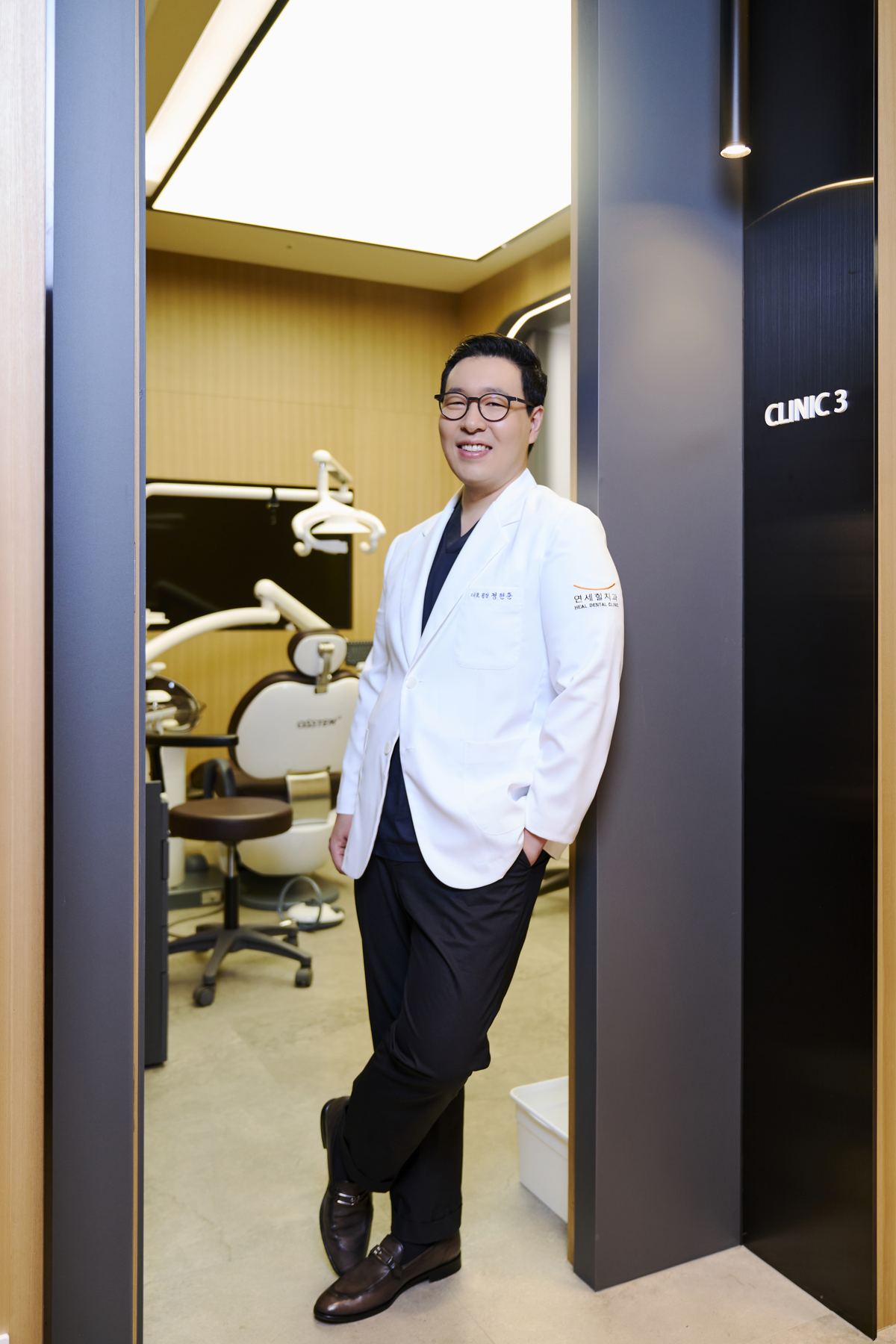
Patients seldom arrive at my clinic saying their veneers are the wrong shade. What they say, almost without exception, is that the teeth look done. The colour is acceptable, the alignment is acceptable, and yet everyone who looks at them registers something the patient cannot name.
In English the shorthand is Chiclets teeth, after the flat, uniformly white chewing gum. Korean patients describe the same thing as baduk stones, the smooth discs used in the board game Go. Two languages, two metaphors, one observation: the teeth look manufactured rather than grown.
A considerable number of the people who raise this with me have flown in from the United States, often having had the work done somewhere else, and their question is usually the same. They want to know whether the problem was the material, the price they paid, or the dentist's hands. In most cases it was none of the three. It was that the restoration did not reproduce the way a natural tooth behaves in light, and that failure was determined during planning, long before any ceramic was fabricated.
Three properties account for nearly all of it.
Colour that does not change across the tooth
A natural incisor is not one colour, and it was never intended to be read as one.
At the cervical third, near the gingival margin, the enamel layer is thin and the underlying dentin is visible through it. Dentin is more saturated and warmer in tone, so this region reads as slightly deeper and yellower. Moving toward the incisal edge, the enamel thickens while the dentin core tapers away, until at the very edge there is enamel with nothing behind it. Light entering that region is not so much reflected back as transmitted and scattered, which renders the edge cooler, greyer, and in many patients faintly translucent.
The result is a gradient: warm and opaque at the base, cool and light permeable at the tip. Every natural anterior tooth in a healthy dentition carries some version of it.
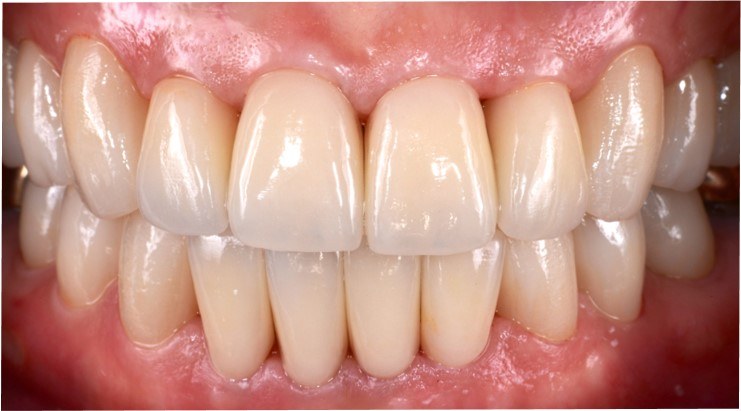
A veneer fabricated to a single flat shade carries none. It returns light at uniform intensity across its entire surface. The observer does not consciously think this restoration lacks a value gradient. The observer simply perceives that something is not right, which amounts to the same thing.
Symmetry that nature does not produce
Contralateral teeth are similar. They are not identical, and the distinction matters more than most patients expect.
The two central incisors typically differ slightly in mesiodistal width, in the contour of the incisal edge, and in how the distal corner rounds away. Lateral incisors vary more still. These differences are small enough that no one consciously notices them in an unrestored smile, and that is precisely why eliminating them is conspicuous.
Perfectly mirrored restorations produce a smile that reads as drafted rather than developed. In my experience the most reliable tell is the incisal edge line. When eight maxillary teeth terminate along one uninterrupted horizontal, the eye identifies it immediately, because a natural incisal plane follows a gentle curve corresponding to the lower lip in speech and in a full smile.
An edge that does not transmit light
This is the property patients feel most reliably and describe least well.
Enamel is translucent. At the incisal edge, where it is unsupported by dentin, light passes into the tooth, scatters within the crystalline structure, and exits. This is why a natural incisal edge can appear faintly blue or grey against a dark background and considerably brighter against a light one. The tooth responds to its surroundings; it is not a fixed object of one colour.
A fully opaque restoration cannot do this. It presents the same appearance under every lighting condition. Under strong illumination it tends to read as flat white, and in flash photography it can render as a solid block against the lips, which is the reason so many patients first notice the problem in a photograph rather than in a mirror.
Reproducing this behaviour is not a refinement applied at the end of treatment. It is the property that determines whether a veneer is perceived as a veneer at all.
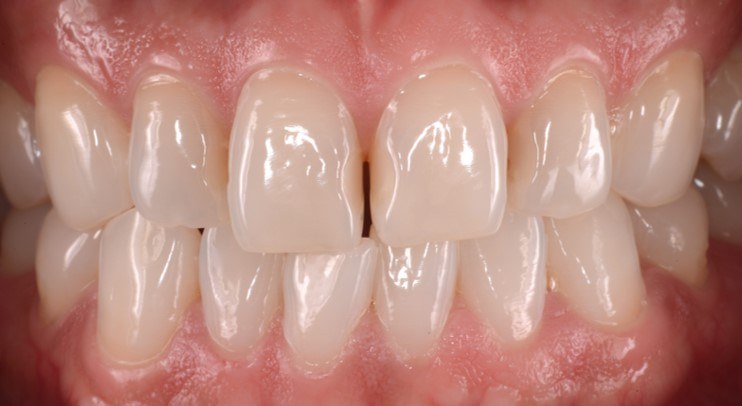 BEFORE
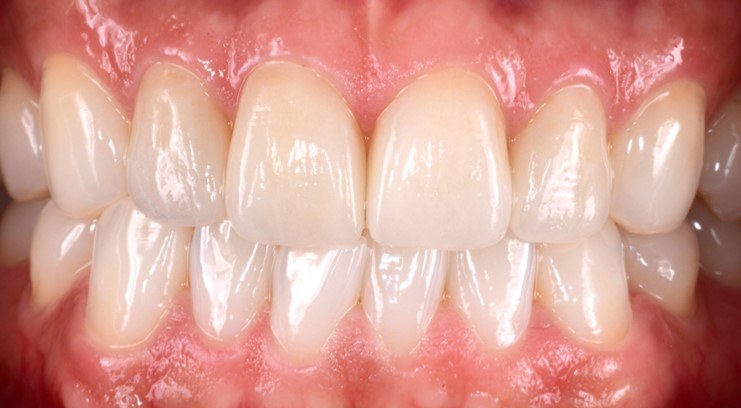 AFTER
AFTERWhere the result is actually determined
What surprises patients is how early the outcome is fixed.
Translucency requires ceramic thickness in specific regions, and thickness requires space. A more translucent ceramic will also transmit whatever lies beneath it, so where the underlying tooth is dark or discoloured, that colour will express through the restoration unless it is deliberately managed. Managing it generally means either creating additional space for layered build up, or selecting a more opaque ceramic that masks the substrate and, in doing so, surrenders a measure of the translucency one was trying to achieve.
That is the substantive trade off in aesthetic veneer work. It is not a question of which ceramic brand is superior. It is a question of how much space is available, what has to be concealed, and what one is prepared to give up in order to conceal it.
This is also why an identical material can yield materially different results in two different mouths, and why a case that succeeded for a friend or a relative may not be the same case as yours.
Planning at a distance
Everything above carries an awkward implication for a patient who does not live in Seoul. If the outcome is governed by examination and planning rather than by the ceramic itself, then someone flying in is entitled to ask how much of that planning can occur before the aircraft lands, and what happens if the examination on arrival contradicts what was assumed from a distance.
I would rather answer that directly than leave it implied.
A meaningful portion of the aesthetic assessment does not require the patient to be in the chair, because much of what governs the result is observable before any instrument touches a tooth: the shade of the underlying teeth, the alignment and rotation of the anterior segment, the position of the lip line at rest and in a full smile, and the patient's own account of what they dislike about their current appearance. That last item is not a soft consideration. Two patients presenting with near identical dentition frequently want materially different outcomes, and eliciting that difference is a conversation rather than a measurement. Remote consultation before a visit is available for this reason.
What cannot be resolved at a distance is the portion requiring direct measurement, and being candid about that boundary matters more than presenting a remote assessment as complete.
A three day treatment window is available to international patients, and the reason deserves stating precisely, because speed is not the achievement. The compression comes from how much has been settled in advance, not from working faster at the chair. Where the pre arrival assessment has been thorough, the days on site are spent executing a plan rather than forming one, which is a different activity with a different failure rate.
Fees follow the same logic. Our published fee for a laminate veneer begins at 600 US dollars per tooth, with a premium option from 840. For a patient traveling from abroad the per tooth figure in isolation is not the useful number; what matters is what the visit as a whole requires. Final cost is determined following examination.
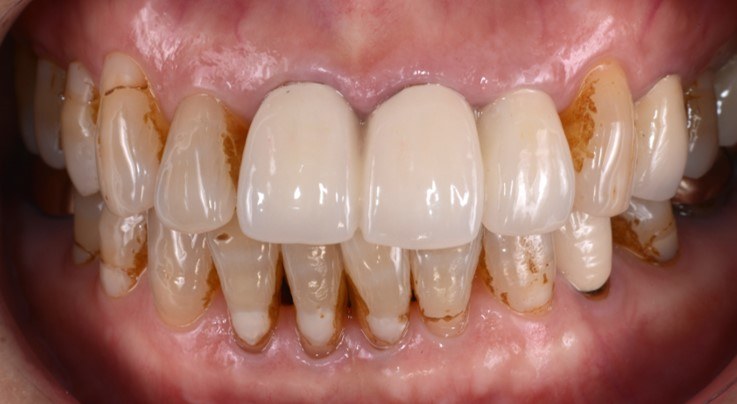 BEFORE
 AFTER
AFTERThe question worth asking at consultation
Most patients open a consultation by asking about material or price. Both are legitimate questions, and both are secondary.
The question that most reliably predicts the result is narrower: what result are you aiming for, and how will you reach it given the condition of my teeth?
A substantive answer refers to your mouth specifically. It notes that your left central is slightly rotated and therefore affords more space on that side; that the substrate shade requires masking in one region but not another; that your lower lip line follows a particular curve which the incisal plane should echo. An insubstantial answer refers only to the practice: that a premium ceramic system is used, that the laboratory is well regarded.
The first answer indicates that someone has examined your teeth and formed a plan. The second indicates nothing at all. This distinction holds regardless of which country you are sitting in, and it is worth applying to a consultation in Los Angeles as rigorously as to one in Seoul.
Frequently asked questions
Do more expensive veneers look more natural?
Not by virtue of cost alone. Material quality is genuine and it matters, but the properties that cause a restoration to read as natural, meaning the value gradient, appropriate asymmetry, and incisal translucency, are established during planning and fabrication. A carefully planned case in a mid range ceramic can appear more natural than a poorly planned one in a premium system.
Can veneers that already appear artificial be corrected?
It depends on the remaining tooth structure and on the reason for the appearance. A discrepancy confined to shade is a different clinical problem from one involving contour or excessive thickness, and the two carry different prospects. This requires direct examination before any assessment can be offered.
Are brighter veneers always more noticeable?
Brightness in itself is not the determining factor. A bright shade rendered with a proper value gradient and a translucent edge can appear entirely natural, while a moderate shade rendered flat and opaque can appear artificial. Uniformity is the tell, not whiteness.
Can any of this be assessed before I travel to Korea?
Remote consultation before a visit is available, and a substantial part of the aesthetic assessment does not require you to be in the chair. The portion requiring direct measurement is completed on arrival. Final treatment options and cost are determined following clinical examination.
How long do porcelain veneers last?
Longevity depends on the ceramic system, the bonding protocol, occlusal loading, and the presence or absence of parafunction such as bruxism. We address this in detail in our guide to veneer longevity. Individual results vary.
Closing
When a restoration is described as looking artificial, the underlying cause is almost never the whiteness of the ceramic. It is that the restoration presents a single colour where a natural tooth presents a gradient, a mirrored contour where a natural dentition presents variation, and a closed surface where enamel would have admitted light.
Each of these follows from the same decision, made at the planning stage: whether the objective was to reproduce the optical behaviour of a tooth, or simply to produce teeth that are white and straight.
For patients considering treatment abroad, that is also the more useful basis for comparison. The question is not which country performs veneers more cheaply. It is whether the clinician you are speaking with, in whichever country, has looked at your teeth and can tell you what they intend to do with them.
This article is for informational purposes and does not constitute dental advice. Individual results vary. Treatment options and final cost are determined following clinical examination. Consult a licensed dental professional for a case-specific evaluation.
Dr. HyunJun Jeong 정현준
Related Articles · 관련 기사
Heal Dental Hospital Seoul (연세힐치과)
Ujangsan Harrington Tower 1F-2F, Gangseo-gu, Seoul, Korea
🌐 365implant.com · 💬 KakaoTalk / 카카오톡 · WhatsApp · ▶ YouTube
Open 7 days a week · English support available · 주 7일 진료 · 방문 전 원격 상담 가능